Common names
Striper
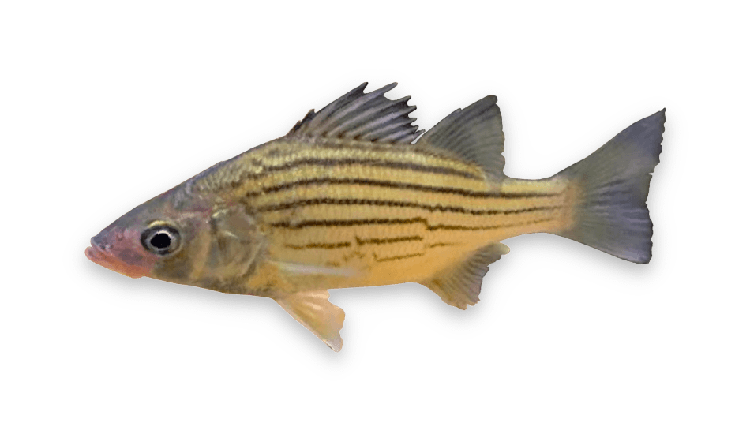
Morone mississippiensis
Striper
The yellow bass is named for its characteristic yellowish-gold body and eyes. Black longitudinal stripes occur as continuous lines along the back, but the lower three or four along the sides and venter are distinctly broken. The lateral line is complete with 50 to 55 scales. The tongue lacks the distinctive tooth patch found on other members of this group. The yellow bass differs further from the white bass by having nine to ten anal rays in comparison to eleven or thirteen. The back of the fish is usually dark olive green, and the abdomen and sides are often silvery yellow.
Occur in pools and backwaters of small to large rivers and also in ponds and lakes surrounding the rivers, especially in areas with dense vegetation and low turbidity. They may move into brackish estuaries.
North America: Lake Michigan and Mississippi River basins from Wisconsin and Minnesota south to the Gulf in the USA; east to Indiana and Tennessee and west to Iowa and Oklahoma in the USA. Lower Mobile Bay drainage in Alabama and from Pearl River drainage in Louisiana to Galveston Bay drainage in Texas, USA.
Juveniles feed on microcrustaceans and midge larvae; adults on fish such as shad & silversides, or small crustaceans. Spawning occurs during the spring with fish swimming into the tributaries to make spawning runs. Spawning usually occurs in moderately shallow waters.
Yellow bass is one of the best-tasting bass. The meat is white and flaky, without any red streaks. For optimal taste, you should remove the red bloodline meat along the lateral line.
Yellow bass are often caught on light tackle, live bait such as minnows, are generally the best option for catching yellow bass, though flies can also work well. Many anglers fish for them during the spring and summer months. Several methods of fishing will work to catch these fish, though bait casting and fly fishing seem to be the most popular. Other methods to try include drift fishing, spin casting, still fishing, and trolling. To catch yellow bass, look for a school of them, then follow them until the lure can be placed in just the right spot Good bait: minnows, garden worms & nightcrawlers.