Common names
Sand Sillago, Summer Whiting, Yellowfin Whiting, Blue-nose Whiting
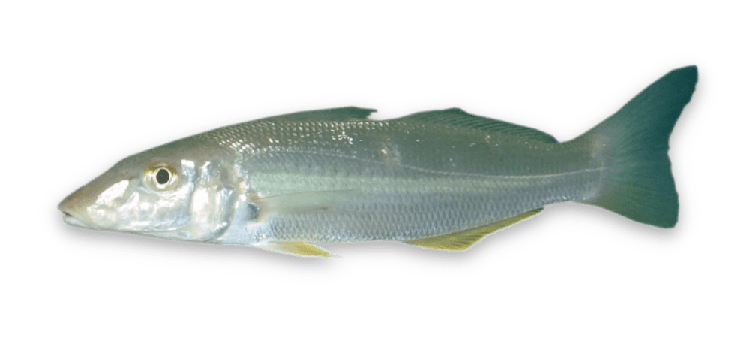
Sillago ciliata
Sand Sillago, Summer Whiting, Yellowfin Whiting, Blue-nose Whiting
Sand whiting have a slightly compressed, elongated body tapering toward the terminal mouth. The dorsal fin is in two parts, the first made of feeble spines and the second of soft rays headed by a single feeble spine, while the ventral profile is straight. Lateral line scales and cheek scales are also distinctive, all of which are ctenoid. They are silvery white in colour, with plain yellowish sides. Dark blotches are present at the base of the pectoral fins. In terms of shape, they are fairly elongated and only slightly compressed. The snout is relatively long and conical. The body is a pale brown or silvery brown colour, transitioning to white below, with green, mauve and rosy reflections when the fish is first removed from the water. An indistinct silver-yellow mid-lateral band extends across some specimens. The spinous dorsal fin is olive green with faint darker blotches, and the second dorsal fin is also a pale olive with rows of dark brown to blackish spots. The anal and ventral fins are pale yellow, and the pectorals are pale yellow to pale brown with a well-defined dark blue-black blotch at the base. The caudal fin is yellow to olive in colour with darker margins. Juveniles may have darker blotches along their sides and backs.
Inhabit the inshore waters including coastal beaches, sand bars, bays, coastal lakes, surf zones, estuaries and rivers as far as the tidal limits.
The sand whiting is distributed along the east coast of Australia from Cape York south to Tasmania, as well as Lord Howe Island and New Caledonia in the Pacific Ocean (also Woodlark Island, Papua New Guinea).
They feed on marine invertebrates, including crustaceans (yabbies, prawns and soldier crabs), polychaete worms and bivalve molluscs (pipis). Sand Whiting use their conical snout to forage for benthic animals through sand and mud. This species is known to bury itself in soft sand and mud when alarmed.
Well regarded for their delicate, sweet white flesh. They are excellent plate-sized fish to Roast or BBQ whole.
Soft plastics are great choices for targeting whiting. Ideally, worm, crab, and minnow imitation plastics worked slowly. Small vibe lures and running assist hooks work best, don’t ever stop your lure, it must be moving at all times or they will lose interest in it very quickly. Good baits: ghost nippers, marine worms, crustaceans, or pippies.
Golden Lined Whiting, Other whiting species