Common names
Albacore tuna, Longfin tuna
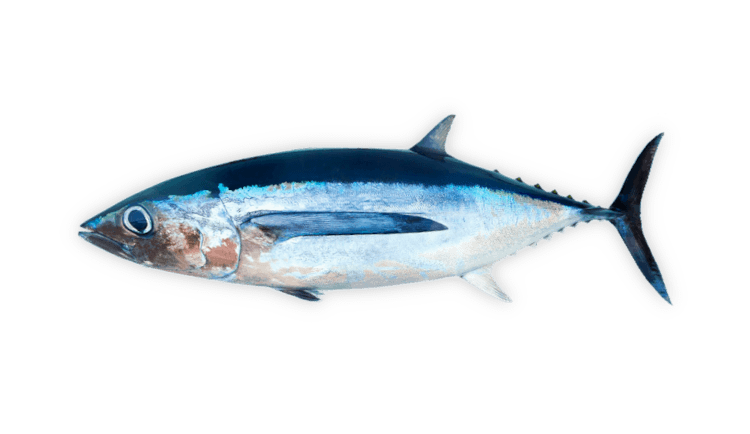
Thunnus alalunga
Albacore tuna, Longfin tuna
Albacore tuna have torpedo-shaped & streamlined bodies with conical snouts, large mouths and big eyes. They are metallic, dark blue on the back with dusky to silvery white coloration along the sides of the belly. They have exceptionally long pectoral fins, which are at least half the length of their bodies, and a crescent-shaped, deeply forked white tail. Albacore tuna is often confused with Juvenile bigeye tuna. Like the fish’s body, the fins are dark blue on top but change to a medium yellow color on the underside. The first dorsal fin is a deep yellow and the second, which is smaller than the first, is a light yellow, as is the anal fin.
It is most often found in surface waters, though larger individuals can be found in deeper waters. It favors areas where warm and cool water mix.
The Albacore has a cosmopolitan distribution. Found in warm temperate and tropical waters across the globe. There are six distinct stocks known globally in the Atlantic, Pacific, and Indian oceans, as well as the Mediterranean Sea. Present in east and south Australian waters and from east of Torres Strait to the northwest shelf.
They are pelagic predators - open-sea hunters. Their diets vary very little from season to season. Unlike other tuna that eat primarily fish, the albacore's main source of food is cephalopods. They are also a highly migratory species, schools of albacore travel great distances, though Atlantic and Pacific populations do not appear to mix. Albacore tuna tend to school by size, as well as with other tuna species. Schools may also occur in association with floating objects. Juveniles tend to school in shallower waters than adults.
The flesh is white to light pink in color and has a fairly firm texture. The flavor is mild. It has a very mild fish flavor. In many ways, it is similar to a baked chicken breast.
Anglers often use trolling methods with artificial lures and live or dead baits to catch Albacore. Popular trolling lures include cedar plugs and tuna feathers. Tuna also respond well to trolled skirted and diving lures. Good baits: pilchards, slimy mackerel, yellowtail.
Similar to Yellowfin tuna, however, Albacore possess an elongated pectoral fin and a distinctive white rear border on the caudal fin, which is unique to this species., Other tuna species