Common names
Bluefin, Japanese central bluefin tuna, SBT, Southern tunny, Southern tuna
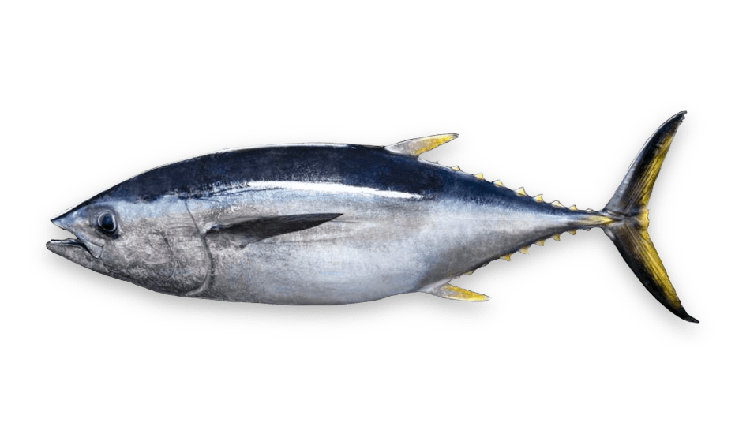
Thunnus maccoyii
Bluefin, Japanese central bluefin tuna, SBT, Southern tunny, Southern tuna
These oceanic predators are impressive in size and power, characterized by a robust, streamlined physique built for swift swimming. They possess an advanced circulatory system that maintains their body temperature above that of the surrounding seawater. The tuna's colouration shifts from a blackish-blue on the upper body to silvery-white below. Notably, they exhibit alternating rows of dots and lines along their body. Other distinctive features include a yellow anal fin and finlets with black margins, along with a first dorsal fin ranging from yellowish to bluish. Two dorsal fins are closely situated, the anal fin is similar in size and shape to the second dorsal fin, located below and slightly behind it. The caudal fin is lunate in shape. The body is covered in cycloid scales, small over the main part of the body and slightly larger in the pectoral regions. The lateral line is moderately arched.
They are pelagic and can be found in both temperate & cold seas.
The species is circumglobal in temperate and cold temperate waters of the southern hemisphere, ranging across the Pacific, Indian, Southern and south-eastern Atlantic oceans, mostly between 30°S and 50°S, to almost 60°S (rare in the Eastern Pacific).
Southern Bluefin Tuna breed between October and March in an area off Java, Indonesia and migrate down the Western Australian coast during their first year. Some fish then head west into the Indian Ocean, while others head eastwards into the Great Australian Bight. Juveniles feed on planktonic crustaceans. Adults are opportunistic predators feeding mainly on pelagic fishes, but also on crustaceans and squid.
Its meaty texture with large flakes, plus its characteristically rich and full flavour, make it the preferred fish for sashimi and sushi dishes. Southern Bluefin Tuna (SBT) are highly valued in global markets, being the most expensive fresh seafood in the world. About 95% of the SBT catch is consumed in high-end Japanese sashimi market.
One of the more productive ways to catch Southern Bluefin is by trolling. The best way to troll for tuna is with a spread of skirted lures, which can range from 6 to 15 inches long. Generally, you have five lure positions in which you stagger the distances of each lure behind the boat, so they don't get tangled when you make tight turns and circles. Good bait: small baitfish (redbait or mackerel) & squid.
Longtail tuna, Other tuna species