Common names
False albacore, Little tuna, Bonita, Blue bonito
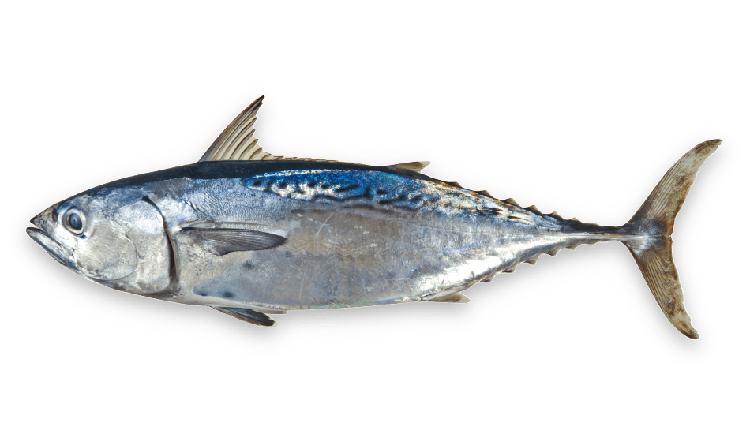
Euthynnus alletteratus
False albacore, Little tuna, Bonita, Blue bonito
The little tunny, smaller compared to other tuna species, features a compact and streamlined body, designed for both rapid bursts of speed and endurance during swimming. Its robust, torpedo-shaped body is tailored for powerful propulsion, complemented by a large mouth with rigid jaws and a slightly protruding lower jaw. The single row of small, inwardly curved, cone-shaped teeth lines the palate. Distinguishing features include a shorter snout relative to the head and a dorsal fin with 10 to 15 tall, descending spines. A smaller second dorsal fin is followed by eight finlets. The body lacks scales except along the lateral line and on the corselet—a thick band of scales encircling the body. Typically adorned in metallic blue or blue-green, the little tunny exhibits dark, wavy stripes above the lateral line. These worm-like lines are within a well-defined border, never extending farther forward than the middle of the first dorsal fin. The belly is bright white, adorned with three to seven dark, fingerprint-like spots around the pectoral and pelvic fins. While it shares coloration similarities with the Atlantic bonito, distinctions in color patterns and overall body size set the little tunny apart.
The little tunny's habitat tends to be near-shore waters, much closer to shore than most other tunas. They live in and around inlets, points, jetties, and sandbars. While the little tunny is abundant in offshore ocean waters, it is unusual to find it in brackish water of estuaries. The very young will enter estuaries in South Africa.
Atlantic Ocean: in tropical and subtropical waters, including the Mediterranean, Black Sea, Caribbean Sea and Gulf of Mexico.
Little tunny, carnivores, primarily feast on fish like Atlantic bigeye and largehead hairtail, supplemented by crustaceans, cephalopods, gastropods, sardines, scad, anchovies, squid, and stomatopods. The little tunny migrates south in the winter and fall, and northward in the spring, through coastal waters. It is not as migratory as other tuna species. The little tunny is typically a schooling species. It lives in schools based primarily on fish size rather than species, so other members of the family Scombridae, like the Atlantic bonito, may be present. These schools cover areas up to 3.2 kilometres long. Little tunny spawn in water that is at least 25 °C (77 °F) in the months of April through November in the Atlantic Ocean.
Due to its robust fish flavour and the substantial preparation effort involved, the little tunny is often deemed a coarse fish and is not widely consumed.
The best technique to catch them is trolling using feather lures, although they can also be caught using jigs and cut bait. Peak season for fishing for little tunny is from May through August. Fly fishing with lightweight bait can also land a little tunny. Just be careful not to yank the line once the fish has taken the bait, otherwise it may break. Other techniques for catching Little tunny include bait casting, drift fishing, fly fishing and spin casting. Lures, such as plugs and spoons are also effective. Good bait: smaller baits, such as mullets, ballyhoos, pinfish, or bluefish.
Skipjack tuna, Frigate tuna, Bullet tuna