Common names
True bonito, Northern bonito
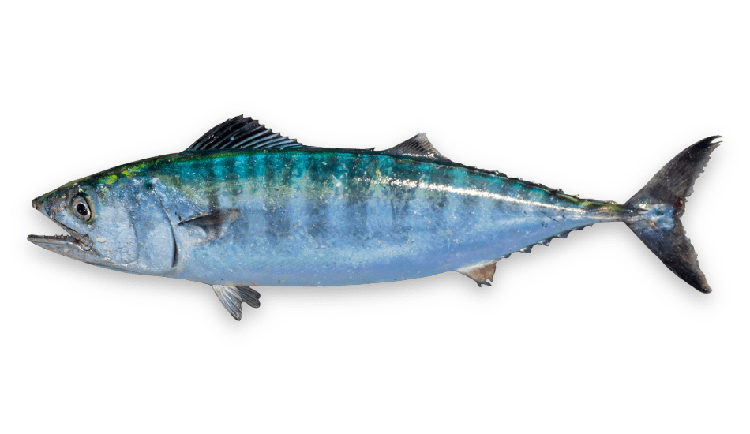
Sarda sarda
True bonito, Northern bonito
Featuring dorsal fins that are very near or separated by a narrow interspace, this species boasts a fully scaled body, with larger scales in the pectoral fin area and along the lateral line. Predominantly silver, they showcase blue-green dorsal fins and distinct black stripes running along the body. The pattern includes mostly straight, diagonal stripes on the back, creating a dark blue colouration on the back and upper sides. Notably, the belly lacks the dark stripes. The Atlantic bonito shares the body shape of tuna species, the only discernible difference being their relatively slender build compared to tuna. Equipped with small, sharp teeth and short pectoral fins, these fish also possess finlets behind the anal fin, contributing to stability during swimming.
Atlantic bonito are a pelagic species, meaning they live in the middle of the sea in the open water. They are not found on the bottom of the ocean or near the top. Sometimes, they will come close to shore and enter estuaries.
Eastern Atlantic: Oslo, Norway to Port Elizabeth, South Africa. Also known from the Mediterranean and Black Sea. Western Atlantic: Nova Scotia, Canada to Florida, USA and northern Gulf of Mexico; then from Colombia, Venezuela, and south of the Amazon River to northern Argentina; apparently absent from most of the Caribbean Sea.
Atlantic bonito eat mackerel, menhaden, alewives, silversides, sand lances, and other fishes, as well as squid. They are strong swimmers, normally they travel in fairly large schools and are known to be cannibalistic. The spawning season is June.
Atlantic Bonito is not a tasty table fare. They are very oily fish and have a strong fishy flavour, which is a detriment to many would-be fish eaters, but because of that it makes them good for bait.
Fast-moving lures or bait is your best bet for luring in Atlantic bonito. The best technique for catching bonito is trolling using feather lures but they’ll just as readily take live bait, cut bait, jigs and soft plastics. Good bait: menhaden, mackerel, sand lance, squid, cut fish, strip baits.
Striped bonito, Skipjack tuna, Little tunny