Common names
Northern bluefin tuna, Giant bluefin tuna, Tunny
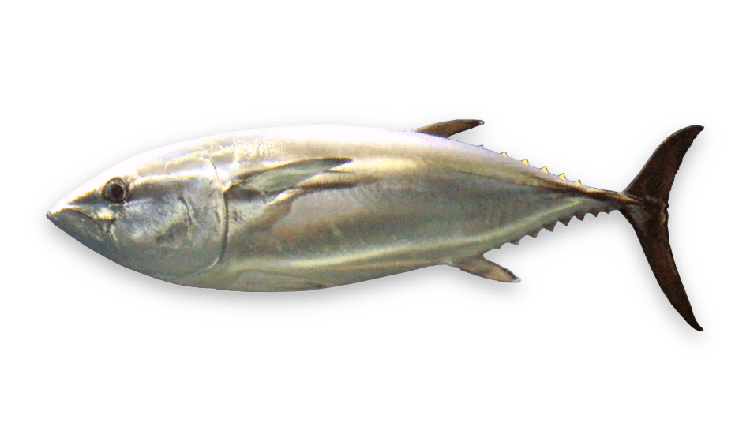
Thunnus thynnus
Northern bluefin tuna, Giant bluefin tuna, Tunny
The Atlantic bluefin tuna is the largest among tuna species, featuring a large, torpedo-shaped body that is nearly circular in cross-section. Its rhomboidal and robust profile can reach impressive dimensions of up to 13 feet and 2,000 pounds. The body showcases a distinctive colouration—metallic blue on top and shimmering silver-white below—which serves as effective camouflage from both above and below, with a golden coruscation covering the body and bright yellow caudal finlets. Notable on their lower sides are colourless lines alternating with rows of colourless spots. The second dorsal fin exhibits a reddish-brown hue, and the pectoral fins are short. A key distinguishing feature of the Atlantic bluefin tuna is the relatively short length of their pectoral fins. Guided by their exceptional sight—having the sharpest vision among bony fish—they hunt with precision.
Atlantic bluefin tuna live near the surface in temperate waters but frequently dive to depths of 500 to 1,000 meters. They are a highly migratory species. They can migrate thousands of miles across an entire ocean.
Western Atlantic: Labrador and Newfoundland to Gulf of Mexico, and Caribbean Sea to Venezuela and Brazil. Eastern Atlantic: Lofoten Islands off Norway to Canary Islands, including the Mediterranean and the southern part of the Black Sea. Reported from Mauritania. There is a subpopulation off the coast of South Africa.
Bluefin tuna, recognized as top predators, engage in spawning from mid-April to June, predominantly in the Gulf of Mexico. Female bluefin tunas exhibit prolific reproduction, capable of producing up to 10 million eggs annually. Their diet evolves as they mature: juveniles consume fish, squid, and crustaceans, while adults predominantly feed on baitfish like herring, bluefish, and mackerel.
Bluefin tuna is a prized seafood delicacy that is not only famous for its taste but also for its numerous health benefits. It is a rich source of lean protein, vitamins, and minerals that can help improve your overall health. It has a distinctive medium-full flavour and firm, “meaty” texture with large flakes. It is best served as sushi or cooked rare to medium-rare.
During the summer months, Atlantic bluefin tuna stick near the surface, basking in the warm sun. In the colder months, they’ll stay at deeper depths, making them more difficult to catch. Successful fishing methods for catching the Atlantic bluefish tuna include drifting and trolling. They will hit on lures, such as spoons, feathers, or plugs, though these generally aren’t as effective as fresh bait. Good bait: live/dead mackerel, mullet, squid, eel, herring, and crustaceans.
Pacific bluefin tuna