Common names
Ahi, Kihada, Albacora
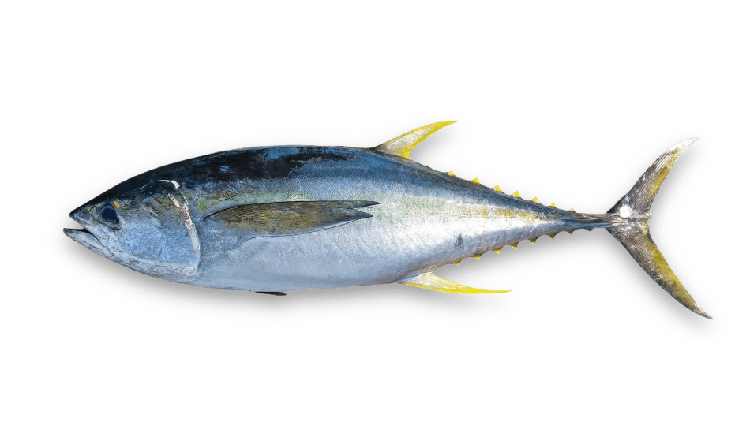
Thunnus albacares
Ahi, Kihada, Albacora
Yellowfin tuna are among the larger tuna species. The second dorsal fin and the anal fin, as well as the finlets between those fins and the tail, are bright yellow, giving this fish its common name (may be also trimmed in black). The second dorsal and anal fins can be very long (about 1/5 of the total length) in mature specimens, reaching almost as far back as the tail and giving the appearance of sickles or scimitars. The pectoral fins are also longer than the related bluefin tuna, but not as long as those of the albacore. The main body is a very dark metallic blue, changing to silver on the belly, which has about 20 golden-yellow vertical lines.
Offshore waters. Yellowfin tuna are epipelagic fish that inhabit the mixed surface layer of the ocean above the thermocline. Sonic tracking has found that although yellowfin tuna, unlike the related bigeye tuna, mostly range in the top 100 m (330 ft) of the water column and penetrate the thermocline relatively infrequently, they are capable of diving to considerable depths.
Worldwide in tropical and subtropical seas, but absent from the Mediterranean Sea.
Yellowfin are able to breed year-round, but spawning peaks in the summer. Yellowfin tuna often travel in schools with similarly sized companions. They sometimes school with other tuna species and mixed schools of small yellowfin, and skipjack tuna, in particular, are commonplace. They are also known to associate with dolphins. Yellowfin tuna prey include other fish (flying fish, sauries, mackerel, anchovies, sardines, etc.), pelagic crustaceans, and squid. Considered a highly migratory species.
Excellent, they have a medium-mild flavour with a very firm texture. Yellowfin tuna is an optimal option for raw preparations. May contain elevated mercury levels.
Can be caught by trolling lures, or fishing live or dead baits at anchor or on the drift. For trolling, you can try tuna feathers, cedar plugs, and plastic skirted trolling lures. Tuna also respond well to diving lures. Good baits: pilchards, slimy mackerel, yellowtail, small skipjack tuna, threadfin herring, menhaden/pogies, blue runners/hardtails, mullet, etc.
Blackfin tuna, T. atlanticus (lacks elongated second dorsal and anal fins), Yellowfin Tuna that have a fork length less than 75 cm can be difficult to distinguish from small Bigeye Tuna (Thunnus obesus), Other tuna species